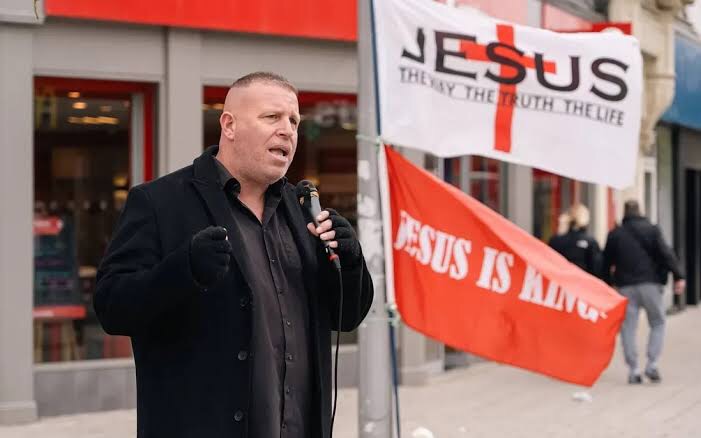
A Christian church in church in Colchester, England, where authorities are reportedly moving to impose criminal restrictions on members engaged in regular public street preaching and open-air evangelism.
The issue has quickly escalated beyond a local council matter and is now becoming a much broader discussion on whether Christian proclamation in public spaces is increasingly being treated as a legal nuisance rather than a protected religious expression.
According to reports surrounding the case, members of the church had consistently taken to public areas within the city to preach the gospel, sing worship songs, distribute Christian materials, and engage passersby in conversations about faith. What had long been viewed by the ministry as a straightforward evangelistic assignment has now attracted complaints, scrutiny, and threats of formal enforcement action.
Local officials are said to be considering measures that could significantly restrict where, when, and how the church carries out its public witness, with some proposals reportedly including criminal consequences if the evangelistic activities continue outside newly proposed limitations.
This development has alarmed many Christian organizations because it touches a sensitive nerve, the question of whether open preaching of biblical truth is gradually becoming unwelcome in Western civic life.
Supporters of the church argue that public evangelism has historically been a visible part of Christian witness, and that peaceful preaching should never be categorized alongside disorderly conduct simply because some members of the public feel uncomfortable hearing religious messages.
They insist that the freedom to proclaim faith openly is a basic democratic right that should not be selectively narrowed.
However, local critics have reportedly claimed that repeated street preaching creates disturbance, tension, and discomfort within shared public spaces, especially in highly diverse communities where many belief systems coexist. This tension between public comfort and public proclamation is now exactly what has made the case explode into national conversation.
Christian legal advocacy groups have also stepped into the matter, warning that if criminal style restrictions are successfully imposed in this instance, it could set a precedent that emboldens other local authorities to begin quietly pushing evangelism out of town centers and visible community spaces. For many believers, that possibility is deeply concerning.
The story has triggered passionate responses online, with many Christians saying the issue is no longer merely about one church in England, but about a broader cultural shift where biblical speech is increasingly tolerated only when kept private and non-confrontational.
Street preaching, by its nature, does not fit neatly into that quiet expectation, and that is why many see the case as symbolic.
Some ministers have pointed out that this is part of a pattern in several Western nations where Christian bakers, teachers, preachers, and evangelists are finding themselves under growing institutional pressure whenever faith expression enters contested public territory.
What makes this particular case so compelling is the emotional contrast it presents. A church sees itself as obeying Christ’s commission to preach the gospel publicly, while civic authorities frame the same activity as a possible public order problem. Between those two viewpoints lies the legal and spiritual battle now capturing international Christian attention.
For believers watching from around the world, one sobering question keeps emerging.
Is the age of fearless public evangelism slowly entering a season where legal caution may become unavoidable?
That is why this story is generating such heavy engagement. It is not merely about regulations. It is about whether the visible public voice of Christianity is being gradually pushed to the margins.