Baby Lynlee “born twice” after surgeons remove life-threatening tumour during pregnancy
a remarkable medical case at Texas Children’s Hospital captured global attention after surgeons operated on a baby girl named Lynlee Hope Boemer while she was still in her mother’s womb.
At around 16 weeks of pregnancy, doctors discovered that Lynlee had developed a rare sacrococcygeal teratoma, a large tumour growing from her tailbone. The mass was drawing heavily from her blood supply and putting increasing pressure on her heart. Doctors feared she might not survive without intervention.
By 23 weeks and five days, her condition had become critical. A team at the Texas Children’s Fetal Center performed open fetal surgery, carefully opening her mother Margaret’s uterus and partially bringing Lynlee outside the womb so they could operate on her.
At the time, Lynlee weighed just 1 pound, 3 ounces. During the operation, her heart briefly stopped and doctors had to restart it. She also required a blood transfusion. The surgical team successfully removed about 90 percent of the tumour before placing her back inside the womb and closing the uterus so the pregnancy could continue.
Her mother then remained on bed rest for around 12 weeks.
At nearly 36 weeks, Lynlee was delivered by Caesarean section on June 6, 2016, weighing 5 pounds, 5 ounces. Because she had already been partially delivered during fetal surgery, her story became widely known as that of the baby who was “born twice.”
Eight days after her birth, Lynlee underwent another operation to remove the remaining tumour.
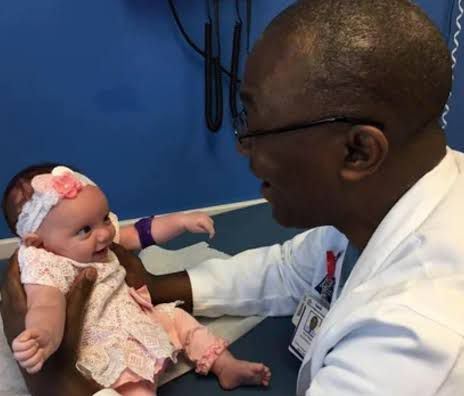
One of the surgeons involved in the case was Nigerian-born pediatric surgeon Dr. Oluyinka Olutoye, who helped perform the rare fetal procedure at Texas Children’s Hospital.
Texas Children’s later reported that Lynlee was doing well, meeting developmental milestones and continuing follow-up care, although doctors noted that the tumour had affected parts of her spine and pelvic muscles and required ongoing monitoring.
The case remains one of the most widely shared examples of fetal surgery, showing how doctors can sometimes treat a life-threatening condition before a baby is even born.
One correction for your graphic: surgeons did not remove the entire tumour at 23 weeks. They removed about 90% before birth, then removed the remainder eight days after Lynlee was delivered.